

A New Mexico court ordered Meta to pay $567 million over AI chatbot harms to minors — making conversational AI guardrails a quantifiable, board-level liability.
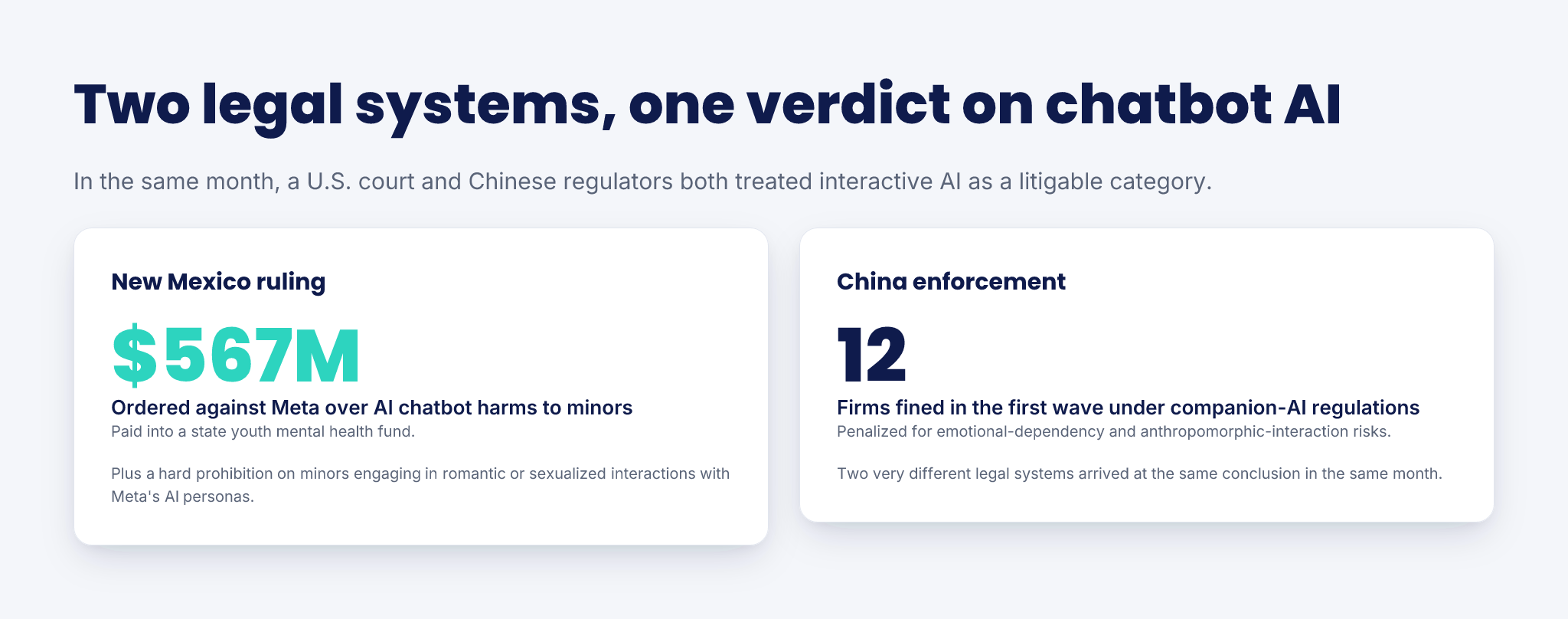
For years, the standard defense for a misbehaving chatbot was some version of "the model said something we didn't intend." A New Mexico court has just put a price tag on that excuse: $567 million, paid into a state youth mental health fund, plus a hard prohibition on minors engaging in romantic or sexualized interactions with Meta's AI personas.
This is not a data-privacy fine or a vague settlement. It is a court treating the behavior of a deployed conversational AI system as a compensable harm — and it should change how every enterprise thinks about interactive AI.
Why this ruling is different
Most AI enforcement to date has targeted inputs and disclosures: what data you trained on, whether you labeled synthetic content, whether you overstated capabilities. The New Mexico ruling targets outputs and outcomes — what the system actually said to a real person, and the downstream harm that followed.
That shift matters for three reasons:
- It uses product-liability and public-nuisance theories, not novel AI statutes. Plaintiffs did not need a bespoke "AI law" to win. Existing frameworks — duty of care, foreseeable harm, consumer protection — already reach chatbot behavior.
- The damages are structural, not symbolic. A payment into a mental-health abatement fund signals that courts view unguarded conversational AI as a societal cost, similar to how opioids and tobacco were litigated.
- The injunction constrains product design. The court didn't just fine Meta; it dictated what the chatbot may and may not do with a protected class of users. That is regulators reaching into your prompt architecture.
And this isn't isolated. In the same window, Chinese authorities issued their first wave of fines under companion-AI regulations, penalizing 12 firms for emotional-dependency and anthropomorphic-interaction risks. Two very different legal systems arrived at the same conclusion in the same month: interactive AI that simulates relationships is a regulated, litigable category now.
The governance gap this exposes
Most enterprise AI inventories capture models, vendors, and spend. Very few capture the dimension that just cost Meta half a billion dollars: who the system talks to, and what it's allowed to say to them.
If your organization deploys any customer-facing conversational AI — support bots, virtual assistants, sales agents, wellness or HR chat tools — you likely have exposure you haven't measured. Ask:
- Can any of our conversational systems be accessed by minors or vulnerable users, even unintentionally?
- Do we have documented guardrails for high-risk conversation topics (self-harm, medical, legal, financial, sexual content)?
- Can we prove those guardrails were tested, not just configured?
- Do we retain conversation-level logs sufficient to reconstruct what the system said if we're sued?
- Who owns chatbot safety — product, legal, or a governance function with authority across both?
If you can't answer these quickly, you don't have a chatbot policy. You have a chatbot hope.
What "reasonable guardrails" now means
The through-line in both the New Mexico ruling and China's enforcement is foreseeability. Courts and regulators are not asking whether you intended harm. They're asking whether a reasonable operator should have anticipated the harmful behavior and failed to prevent it.
That standard turns guardrails from a nice-to-have into an evidentiary requirement. Practically, a defensible posture includes:
- Age and vulnerability controls — knowing who is on the other end, and restricting capabilities accordingly.
- Topic-level refusal and escalation policies — codified, versioned, and mapped to known risk categories.
- Adversarial and red-team testing targeting exactly the failure modes that produce liability, aligned to structured methodologies like NIST's emerging TEVV-Athlon evaluation pathways.
- Immutable conversation logging so you can demonstrate what happened — and prove your controls were active — after the fact.
- A named accountable owner with authority to pull a system that can't meet these bars.
Turning a headline into a control
The instinct after a ruling like this is to audit one chatbot and move on. That's the wrong scope. The lesson is that conversational risk is a category, not an incident — and it needs to live in your governance program as a measurable dimension, not a one-time review.
For evum users, that means treating chatbot safety the way you treat any other governance gap:
- Inventory every conversational AI system, including shadow deployments embedded in SaaS tools.
- Assess each against guardrail, testing, logging, and ownership criteria.
- Score the exposure so leadership sees where the $567M-shaped risks actually sit.
- Prioritize remediation as concrete initiatives with owners and deadlines — not aspirations.
The organizations that get hurt by rulings like this aren't the ones that lacked a policy on paper. They're the ones who couldn't demonstrate the policy was enforced when it mattered.
Conversational AI just became one of the most legally exposed categories of enterprise technology. The regulators and the courts have both signaled that "the model said it, not us" is no longer a defense. The question your board will ask isn't whether your chatbots are helpful. It's whether you can prove they're safe — and whether you can find them all in the first place.